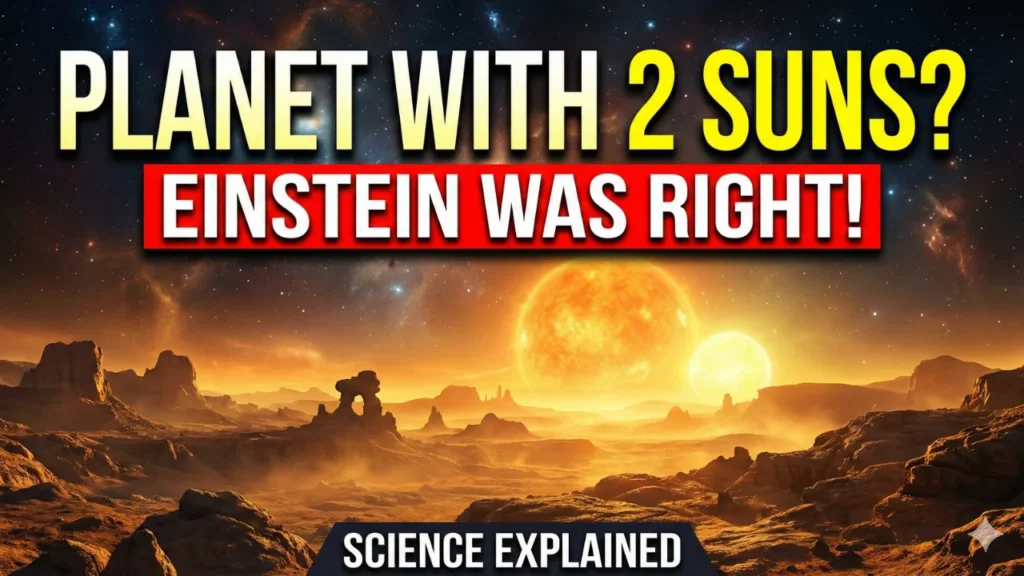
The idea of a planet with two suns sounds like something from science fiction. Many people imagine a sky glowing with double sunlight or dramatic sunsets with two bright stars. However, science shows that such planets are not only possible but already discovered in our universe.
Interestingly, the physics behind these worlds connects to principles explained by Albert Einstein and later developments in astrophysics. Let’s explore how a planet with two suns can exist and what science says about it.
What Is a Planet with Two Suns?
A planet with two suns usually orbits a binary star system. In these systems, two stars revolve around each other due to gravity.
Instead of orbiting one star like Earth does, the planet orbits both stars together. This type of planet is known as a circumbinary planet.
In simple terms:
- Two stars move around each other
- The planet moves around both stars
- The sky may show two bright suns
Such systems are real and have been confirmed by astronomers.
How Einstein’s Theory Connects to Binary Systems
Albert Einstein developed the theory of general relativity, which explains how gravity works on a cosmic scale.
Einstein showed that:
- Massive objects bend space-time
- Gravity affects how stars and planets move
- Orbital paths depend on gravitational balance
In a binary star system, gravity from both stars influences planetary motion. Einstein’s equations help scientists understand how such complex systems remain stable.
Without a clear understanding of gravitational interaction, predicting stable orbits in two-star systems would be difficult.
Are Planets with Two Suns Real?
Yes, astronomers have discovered several circumbinary planets. Advanced telescopes and space missions confirm their existence.
These planets may:
- Experience unusual seasonal patterns
- Have changing light intensity
- Show complex orbital behaviour
Some systems show that the planet’s orbit remains stable for millions of years.
How Stable Are These Planets?
A common question is whether a planet with two suns can support life.
Stability depends on:
- Distance from the stars
- Gravitational balance
- Orbital alignment
If the planet orbits far enough from the two stars, it can maintain a stable path. If it is too close, gravitational forces may disrupt the orbit.
Scientists use Einstein’s gravitational principles to simulate these systems and predict long-term stability.
What Would the Sky Look Like?
If you stood on a planet with two suns, the sky could appear dramatic.
Possible features include:
- Double sunrise and sunset
- Extended daylight hours
- Brighter atmosphere
- Complex shadow patterns
However, actual visibility depends on orbital positions.
Sometimes, the two suns may appear close together. At other times, they could be on opposite sides of the sky.
How Do Binary Star Systems Form?
Binary stars form from the same cloud of gas and dust during star formation.
Instead of forming one star, gravity causes the material to split into two separate stars orbiting each other.
Binary systems are common in our galaxy. In fact, many stars exist in pairs rather than alone.
This increases the possibility of planets forming around them.
Could Life Exist on a Planet with Two Suns?
Life depends on stable temperature conditions and suitable energy levels.
A planet with two suns could theoretically support life if:
- It lies in the habitable zone
- It maintains stable temperatures
- Radiation levels remain manageable
Researchers continue studying these systems to understand potential habitability.
Why the Concept Fascinates People
The idea of a planet with two suns captures imagination because it feels extraordinary.
It challenges:
- Traditional views of planetary systems
- Our understanding of solar structure
- Ideas about what is “normal” in space
Science continues proving that the universe is far more diverse than once believed.
Modern Discoveries and Research
Modern telescopes allow astronomers to detect planets using:
- Transit observations
- Gravitational measurements
- Light variations
These techniques confirm that multi-star systems can host planets.
As technology improves, scientists may discover even more complex systems.
FAQs
Yes, several circumbinary planets have been discovered.
It is a system where two stars orbit each other.
Einstein’s gravitational theories help explain how such systems remain stable.
It depends on temperature stability and radiation levels.
Yes, many stars in the galaxy exist in pairs.
Final Thoughts
The idea of a planet with two suns may sound fictional, but science confirms it is possible. Thanks to Einstein’s groundbreaking work on gravity, scientists understand how these complex systems function.
As research continues, we may learn more about these fascinating worlds and whether they could support life. The universe remains full of surprises, and discoveries like this remind us how much there is still to explore.

Diana Luci is a U.S.-based Latest and financial news writer covering Social Security, IRS tax updates, SNAP benefits, Medicare, and government assistance programs. She focuses on simplifying complex financial and policy topics into clear, easy-to-understand information for everyday readers.