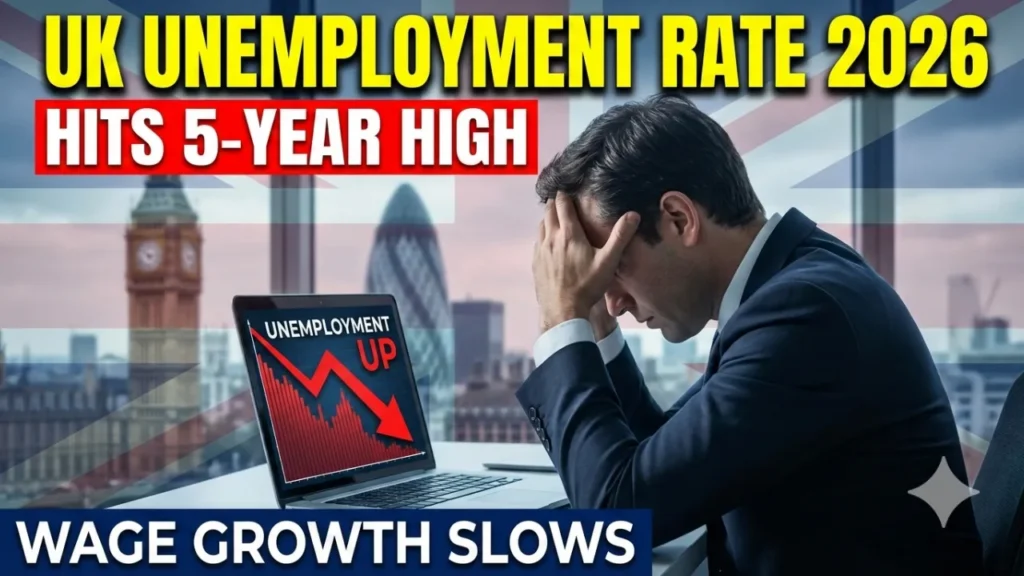
The UK Unemployment Rate 2026 has climbed to its highest level in five years, raising fresh concerns about the strength of the job market. At the same time, wage growth has slowed, creating pressure for households already dealing with higher living costs.
Although employment levels remain relatively stable compared to past crises, the latest figures show clear signs of strain. As a result, many workers are asking what this change means for their income, job security and future opportunities.
What the Latest Unemployment Data Shows
Recent labour market figures confirm that unemployment has increased compared with last year. The rise marks the highest rate seen in five years.
At the same time:
- Wage growth has slowed
- Hiring momentum has cooled
- Youth unemployment shows signs of rising
- Some sectors report fewer vacancies
Although the increase is not dramatic, the shift signals that the labour market is losing some of its previous strength.
Why Is the UK Unemployment Rate 2026 Rising?
Several economic factors are contributing to the increase.
First, businesses are facing higher borrowing costs. When interest rates remain elevated, companies often delay expansion plans. As a result, hiring slows.
Second, consumer demand has softened. When households spend less, businesses generate lower revenue. Consequently, some employers reduce recruitment or freeze hiring.
Third, global economic uncertainty has affected trade and investment. International pressures often influence domestic job markets.
Together, these factors have created a more cautious employment environment.
Wage Growth Is Also Slowing
At the same time as unemployment rises, wage growth has cooled.
Previously, strong wage increases helped workers cope with inflation. However, slower pay growth now means:
- Real income growth may weaken
- Household budgets remain tight
- Savings become harder to build
Although wages are still growing, the pace has slowed compared to earlier periods.
Which Sectors Are Most Affected?
Not all industries experience the same pressure.
Some sectors showing signs of slowdown include:
- Retail
- Construction
- Hospitality
- Administrative services
On the other hand, areas such as healthcare and certain technical roles remain more stable.
Because of this uneven impact, regional differences may also appear across the country.
Youth Unemployment Concerns
Youth unemployment often reacts more quickly to economic shifts. Early signs suggest younger workers may face increasing challenges.
When businesses become cautious, entry-level hiring often slows first. Therefore, graduates and school leavers may encounter more competition for roles.
Supporting young job seekers could become a key focus in the coming months.
What This Means for Interest Rates
The UK Unemployment Rate 2026 also influences decisions by the Bank of England.
When unemployment rises and wage growth slows, pressure on inflation may ease. As a result, policymakers may consider adjusting interest rates in the future.
However, decisions depend on broader economic conditions, including inflation trends and global risks.
Impact on Households
For many families, even a small rise in unemployment creates concern.
Possible household impacts include:
- Greater job insecurity
- Reduced confidence in spending
- Tighter budgeting
- Delayed financial plans
At the same time, workers who remain employed may feel cautious about career moves.
Is This a Recession Signal?
Although unemployment has reached a five-year high, this does not automatically mean the UK is entering a recession.
Economists examine multiple indicators before drawing conclusions. These include:
- GDP growth
- Consumer spending
- Business investment
- Inflation trends
While the labour market has weakened slightly, the overall economy remains under close observation.
What Workers Can Do Now
Although economic shifts are outside individual control, there are practical steps workers can take.
First, update your CV and professional profile. Even if you feel secure in your role, staying prepared helps.
Second, build an emergency savings buffer where possible. Even small amounts set aside monthly can provide security.
Third, consider upskilling. Many industries value digital and technical skills that increase employability.
Finally, stay informed about labour market trends in your region and sector.
Employer Response to Labour Market Changes
Employers are also adjusting strategies.
Some companies may:
- Slow recruitment
- Focus on productivity improvements
- Offer flexible working to retain staff
- Invest in automation
However, others may continue hiring in growth areas. Therefore, opportunities still exist, especially in high-demand fields.
Government and Policy Outlook
Rising unemployment often leads to political and policy discussions.
Government responses may include:
- Employment support programmes
- Training initiatives
- Business investment incentives
- Youth employment schemes
Future announcements could focus on stabilising the labour market while supporting economic growth.
Is the Situation Likely to Worsen?
Predicting labour market trends remains difficult. Much depends on inflation, global markets and domestic business confidence.
If economic conditions stabilise, unemployment could level off. On the other hand, prolonged uncertainty may lead to further increases.
For now, the data shows pressure but not crisis.
FAQs
It has risen to its highest level in five years, according to recent labour market data.
Higher borrowing costs, slower hiring and weaker consumer demand are contributing factors.
Yes, but growth has slowed compared to earlier periods.
Retail, construction and hospitality show signs of cooling, while healthcare remains more stable.
Not necessarily. Economists consider several indicators before confirming a recession
Final Thoughts
The rise in the UK Unemployment Rate 2026 reflects a cooling labour market after a period of stronger growth. Although the increase has raised concern, the situation remains manageable at present.
Workers and employers alike are adjusting to changing economic conditions. Staying informed, building financial resilience and developing skills can help individuals navigate this period more confidently.
While uncertainty continues, preparation and awareness remain the strongest tools for facing labour market changes.

Diana Luci is a Senior Financial Analyst and Policy Researcher based in the US. She specializes in breaking down complex government updates, IRS changes, and economic trends into clear, actionable insights for everyday Americans.