The latest U.S. labor market report brought encouraging news as US jobless claims fell more than economists expected, reinforcing confidence that employers continue to hold onto workers despite ongoing economic uncertainty.
According to the U.S. Department of Labor, initial unemployment benefit applications dropped to 215,000 for the week ending June 20. Economists had expected claims to reach around 225,000, making this week’s report a positive surprise.
Although hiring has slowed in recent months, the lower number of new unemployment claims suggests layoffs remain limited across many industries.
Read Also- These 5 Retirement Rule Changes Could Affect Millions of Americans in 2026
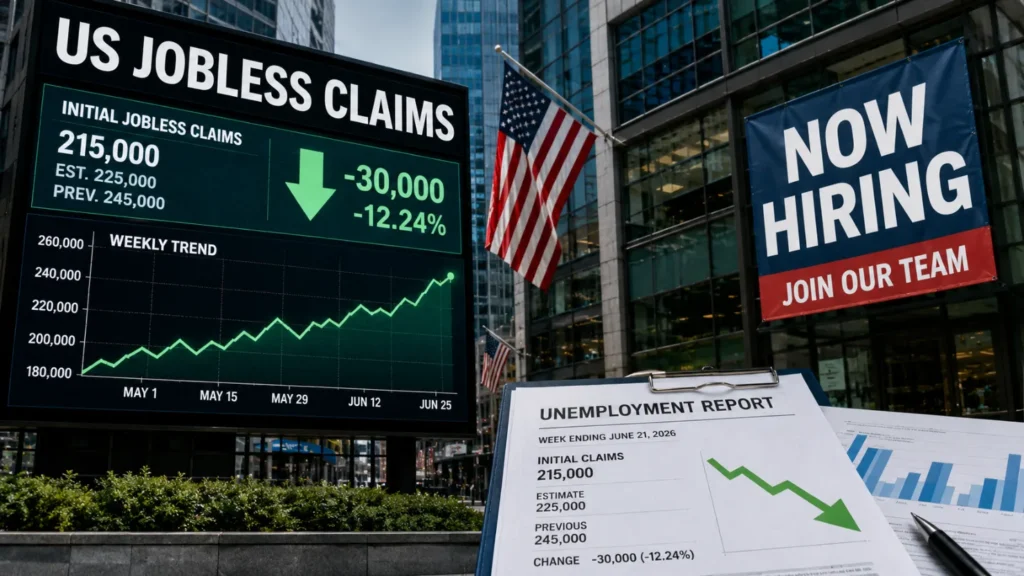
US Jobless Claims Fall More Than Expected as Labor Market Holds Firm
| Initial Jobless Claims | 215,000 |
| Forecast | 225,000 |
| Previous Week | 227,000 (Revised) |
| Continuing Claims | 1.821 Million |
| Unemployment Rate | 4.3% |
| Report Released By | U.S. Department of Labor |
US Jobless Claims Beat Expectations
The biggest takeaway from this week’s report is that layoffs remain under control.
New unemployment claims fell by 12,000 from the previous week, bringing the total to 215,000. This result came in well below market expectations and signals that businesses are still avoiding widespread job cuts.
While seasonal factors, including the Juneteenth holiday and the end of the school year, may have influenced the weekly data, economists believe the overall labor market remains stable.
Hiring Is Still Moving Slowly
Even though fewer people filed for unemployment benefits, another part of the report shows employers are hiring more carefully.
Continuing claims, which measure people still receiving unemployment benefits after their first application, increased to 1.821 million. This suggests some job seekers are taking longer to secure new employment.
Many companies continue to manage costs carefully while evaluating future hiring needs.
What This Means for the Economy
Weekly unemployment claims are one of the earliest indicators of labor market health.
Lower claims generally indicate:
- Fewer layoffs
- Stable business conditions
- Strong consumer confidence
- Continued economic resilience
However, economists also note that hiring has cooled compared with previous years, meaning the labor market is stable but no longer expanding as rapidly.
Federal Reserve Keeps Watching Labor Data
Employment data remains one of the most important factors influencing Federal Reserve policy.
A resilient labor market gives policymakers more flexibility as they balance inflation with economic growth. Future reports on employment, wages, and inflation will likely play a key role in upcoming interest-rate decisions.
Read Also-July 2026 Social Security Payment Dates Explained: Who Gets Paid and When?
Challenges Remain for Job Seekers
Although layoffs remain low, many Americans are still finding it harder to land new jobs.
Hiring has become more selective, particularly for entry-level positions. Recent graduates and long-term unemployed workers continue to face a competitive job market as companies slow recruitment and invest more in automation and artificial intelligence.
Outlook
The latest US jobless claims report points to a labor market that remains on solid ground. Businesses are largely avoiding layoffs, but hiring has yet to regain stronger momentum.
Upcoming employment reports will help determine whether this stability continues through the second half of the year.
Frequently Asked Questions
What are US jobless claims?
US jobless claims measure the number of people filing for unemployment benefits for the first time during a week.
Why did jobless claims fall?
Initial claims declined to 215,000, below economists’ expectations of 225,000, indicating fewer workers were laid off.
What are continuing claims?
Continuing claims represent people who continue receiving unemployment benefits after their initial application.
Does lower jobless claims mean the economy is improving?
Lower claims generally suggest employers are keeping workers, though economists also monitor hiring, wages, and inflation for a complete picture.
What should investors watch next?
The next monthly jobs report, inflation figures, and future weekly jobless claims will provide more insight into the strength of the U.S. economy.
The latest US jobless claims data offers another sign that the U.S. labor market remains resilient despite slower hiring. While companies continue to recruit cautiously, the relatively low level of layoffs is an encouraging signal for workers and the broader economy.
Read Also-Getting a New Direct Express Card? Here’s What Social Security Recipients Should Know

Diana Luci is a U.S.-based Latest and financial news writer covering Social Security, IRS tax updates, SNAP benefits, Medicare, and government assistance programs. She focuses on simplifying complex financial and policy topics into clear, easy-to-understand information for everyday readers.