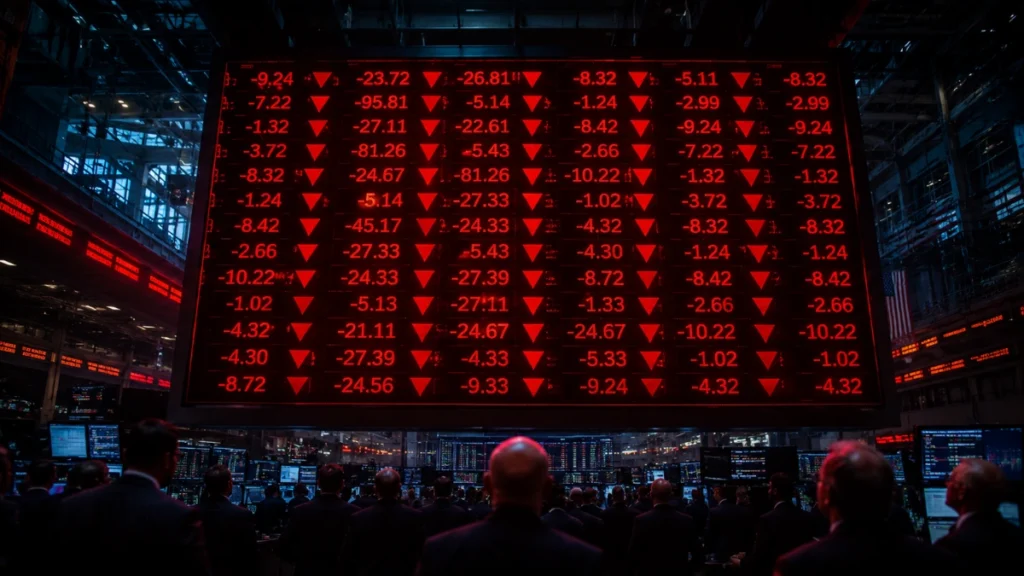
A sudden and aggressive wave of anxiety hit the financial sector this Tuesday, completely erasing early-week market gains. Driven by an unexpected spike in global energy costs and growing geopolitical instability in the Middle East, resurging US inflation fears July 2026 have forced investors to rapidly dump riskier assets.
The tech-heavy Nasdaq led the downward spiral, dropping nearly 2% in intraday trading as traders frantically reassessed their portfolios ahead of this week’s critical macroeconomic data releases.
The immediate market reversal underscores just how fragile the current economic recovery remains.
Read Also-June PPI Report 2026: What Wall Street Expects This Wednesday
Shifting Fed Timelines Fuel the Market Panic
The primary catalyst for the sudden market rout is the rapid adjustment of interest rate expectations. Up until this week, institutional investors were cautiously optimistic that the Federal Reserve would maintain its steady pause through the end of the summer.
However, the latest energy sector data has completely disrupted those projections. With Brent crude spiking over supply line anxieties, consumer price projections are pointing higher once again.
Derivatives markets have reacted violently to these shifts, with overnight index swaps now indicating a staggering 50% probability that the Federal Reserve will actually execute an interest rate hike at their upcoming late-July meeting.
This hawkish shift is creating a severe ripple effect across the banking sector. Borrowing costs are projected to remain elevated much longer than previously anticipated, putting immense pressure on corporate growth margins.
Read Also-Delta Air Lines Q3 Guidance: Why Strong Travel Demand Couldn’t Stop a Stock Dip
The Broad Impact of Resurging US Inflation Fears July 2026
The damage from today’s market selloff was felt most acutely across the technology and semiconductor industries.
Market leaders that have carried the broader indexes for months experienced intense profit-taking, as portfolio managers scrambled to shield their capital from rising yields. The sudden spike in the 10-year Treasury yield serves as a clear indicator that fixed-income investors are pricing in a much stickier inflationary environment.
Retail investors are being urged to brace for continued volatility as the market awaits the official Consumer Price Index (CPI) numbers.
If the upcoming federal reports confirm that consumer costs are indeed accelerating, the pressure on the central bank to tighten monetary policy even further will become impossible to ignore, potentially locking the US economy into a prolonged high-rate cycle well into next year.
Read Also- July Fed Decision 2026: Why Wall Street is Bracing for Surprises Under Kevin Warsh

Diana Luci is a U.S.-based Latest and financial news writer covering Social Security, IRS tax updates, SNAP benefits, Medicare, and government assistance programs. She focuses on simplifying complex financial and policy topics into clear, easy-to-understand information for everyday readers.