If you woke up on this holiday weekend wondering, “is there a rocket launch today?”, you are not alone. Space enthusiasts across Florida and the entire United States were treated to a spectacular Sunday morning liftoff.
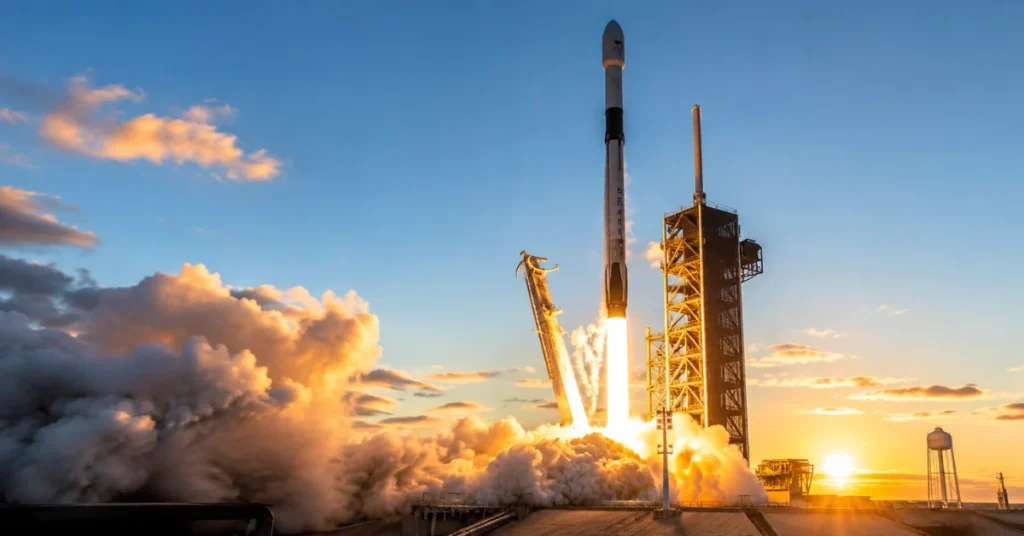
Following an incredibly busy week of aerospace activity, SpaceX successfully launched another Falcon 9 from the Space Coast on July 5, 2026, bringing both new internet infrastructure and experimental manufacturing technology into low-Earth orbit.
Here is a complete breakdown of the Starlink 10-50 mission, including what time it happened and the surprising bonus payload attached to the rocket.
Read Also- Kerr Kriisa Arrest: FBI Detains Former College Basketball Guard
What Time Was the SpaceX Rocket Launch Today in Florida?
For those eagerly searching the web for a rocket launch today, the action kicked off bright and early. The Falcon 9 rocket roared to life at exactly 6:46 a.m. EDT from Space Launch Complex 40 (SLC-40) at the Cape Canaveral Space Force Station. The weather over the Atlantic was highly cooperative, allowing for a smooth ascent into the Sunday morning sky.
If you missed the live webcast, you can easily catch the replay on the official SpaceX channels. Roughly eight and a half minutes after liftoff, the first-stage booster smoothly returned to Earth, successfully touching down on the “A Shortfall of Gravitas” droneship stationed in the Atlantic Ocean.
Impressively, this marked the 13th successful flight for this specific booster, which has previously supported several major missions, including Crew-10 and multiple previous broadband satellite deployments.
Read Also- Cheyenne Water System Bacteria Issue: Meta Data Center Discharges Suspended
The Starlink 10-50 Payload and the Besxar Fabships
The primary goal of this weekend’s mission was to continue expanding the massive global broadband network. Over an hour after liftoff, the upper stage successfully deployed a batch of 29 Starlink V2 Mini Optimized satellites into low-Earth orbit.
However, this flight also featured a fascinating, cutting-edge secondary objective. Integrated directly onto the Falcon 9 first-stage booster were two “Fabships.” Developed by Besxar Space Industries, these pilot reusable manufacturing pods serve as a semiconductor testing bed.
The goal was to subject the pods to the intense physical environments of launch and re-entry, kicking off a critical series of flight tests for in-space manufacturing development.
With this successful deployment wrapping up the holiday weekend, the aerospace community is already looking forward to the upcoming Transporter-17 rideshare mission scheduled for later this week in California.
Read Also- Deadly Venezuela Terremoto: Death Toll Approaches 3,000 Amidst Rescue Operations

Diana Luci is a U.S.-based Latest and financial news writer covering Social Security, IRS tax updates, SNAP benefits, Medicare, and government assistance programs. She focuses on simplifying complex financial and policy topics into clear, easy-to-understand information for everyday readers.