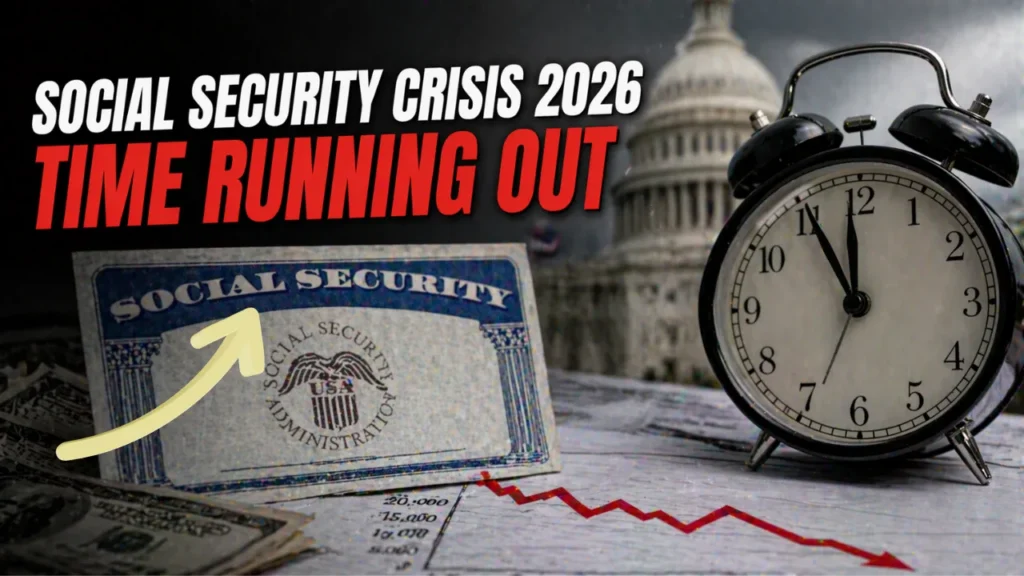
Concerns around retirement security in the United States are growing rapidly as new projections highlight the deepening Social Security Crisis 2026. Experts warn that while the system is not beyond repair, the window to fix it is getting smaller with each passing year.
The debate is now shifting from whether changes are needed to how quickly lawmakers can act.
Social Security COLA 2026: 5 Key Facts Retirees Need to Know
Why the Social Security Crisis 2026 Is Getting Worse
At the center of the issue is a widening financial gap. Social Security is funded mainly through payroll taxes paid by current workers. However, as more Americans retire and fewer workers contribute, outgoing payments are beginning to exceed incoming funds.
According to recent projections, the main trust fund could run out by 2032 if no changes are made.
If that happens, benefits would no longer be fully funded. Payments could drop by around 7% initially, with potential reductions of up to 28% over time. This growing imbalance is what defines the current Social Security Crisis 2026.
Social Security Cap Proposal Could Protect Trust Funds-But There’s a Catch
Experts Say It’s Not Too Late
Despite the urgency, financial experts agree the system can still be stabilized. The challenge is not a lack of solutions it is the political difficulty of implementing them.
Most proposed fixes involve trade-offs that are unpopular with voters. Still, experts stress that early action could prevent more severe changes later.
Key Solutions Being Discussed
Several policy options are being considered to address the Social Security Crisis 2026.
Raising Payroll Taxes
One approach involves increasing payroll taxes or expanding the income cap subject to Social Security taxation.
Currently, earnings above a certain threshold are not taxed. Raising or eliminating this cap could bring in significant additional revenue.
Some experts suggest increasing the taxable income limit to $300,000 or applying taxes to all income levels.
However, this option could increase financial pressure on working Americans.
Social Security May 2026 Payment Timing: Longer Gap Explained for Millions of Americans
Reducing Benefits for High Earners
Another proposal focuses on limiting benefits for higher-income retirees.
This could involve adjusting benefit formulas or slowing future growth rates. Some experts support switching from wage-based indexing to inflation-based indexing, which would gradually reduce long-term payouts.
This method aims to preserve benefits for lower-income retirees while cutting costs at the top.
Raising the Retirement Age
Increasing the full retirement age is also under consideration.
With Americans living longer, some policymakers argue that extending working years could reduce pressure on the system.
However, critics point out that this could disproportionately affect workers in physically demanding jobs or those with shorter life expectancies.
Social Security Cap Proposal: $100K Benefit Limit Could Change Retirement
Why Every Solution Comes With a Catch
The complexity of the Social Security Crisis 2026 lies in the fact that every solution has drawbacks.
- Higher taxes can burden workers
- Benefit cuts face public resistance
- Raising retirement age may impact vulnerable groups
Because of this, experts believe the most realistic solution will involve a combination of multiple strategies rather than a single fix.
Timing Could Decide the Outcome
One of the biggest risks is delay.
The closer the system gets to the projected 2032 deadline, the harder it becomes to implement gradual changes. Waiting too long could force sudden and more aggressive adjustments.
Experts emphasize that acting sooner allows for smaller, more manageable reforms.
What This Means for Americans
For current retirees, there are no immediate changes.
Benefits are being paid as scheduled, and no approved policy has reduced payments so far. However, younger workers and future retirees may face a different system if reforms are implemented.
The ongoing Social Security Crisis 2026 highlights the importance of planning beyond government benefits.
Social Security Dependence Reveals Major Retirement Risk for Millions
Pressure Is Building in Washington
The growing attention around the Social Security Crisis 2026 is putting pressure on lawmakers to act.
With millions of Americans relying on Social Security, the stakes are high. Any decision will need to balance financial sustainability with fairness for current and future beneficiaries.

Diana Luci is a U.S.-based Latest and financial news writer covering Social Security, IRS tax updates, SNAP benefits, Medicare, and government assistance programs. She focuses on simplifying complex financial and policy topics into clear, easy-to-understand information for everyday readers.